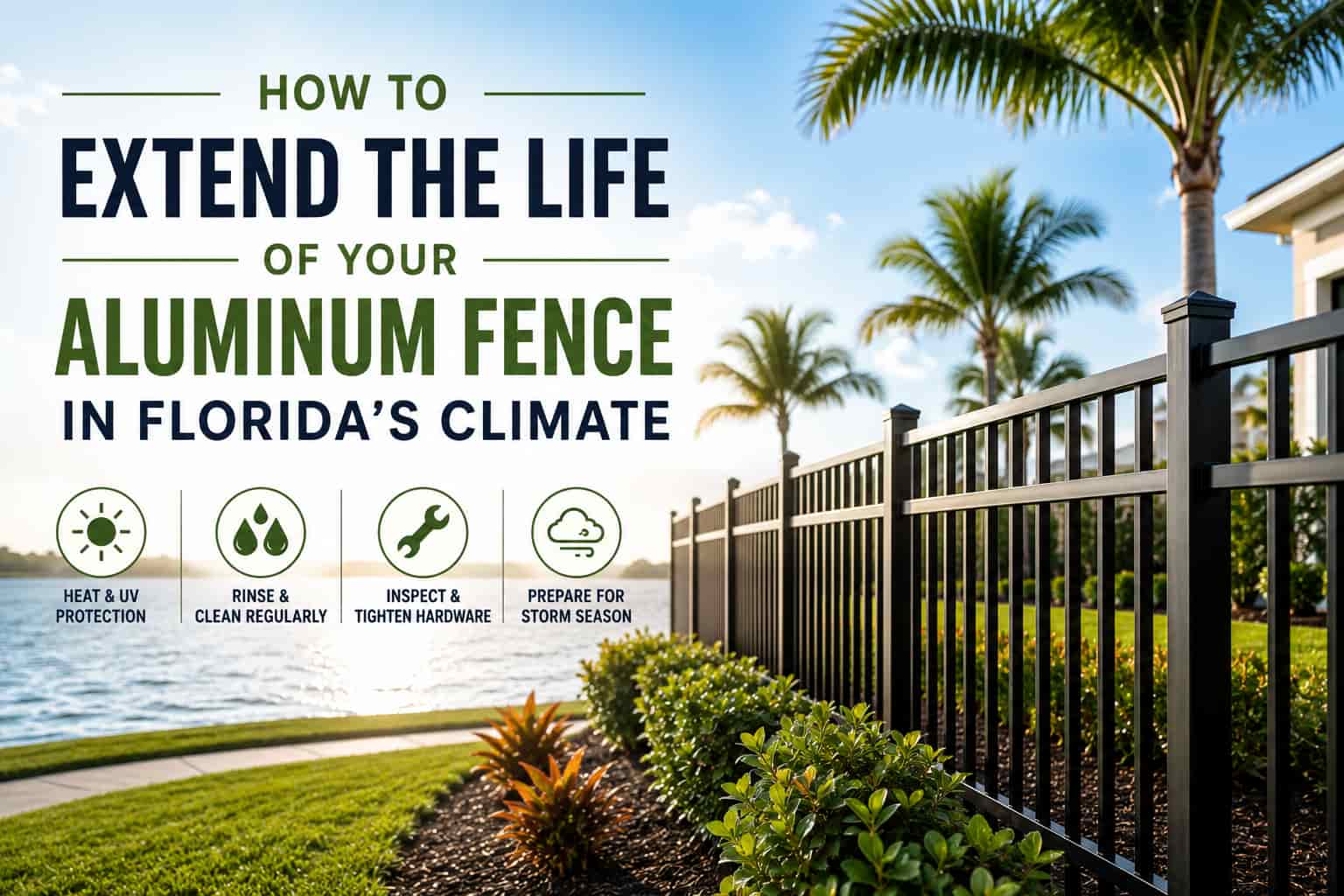
How to Extend the Life of Your Aluminum Fence in Florida's Climate
Quick Answer: Aluminum Fence Care in Florida
An aluminum fence in Florida can last 20+ years if you rinse it every 1–2 months to remove salt and pollen, inspect and tighten hardware twice a year, touch up scratches before corrosion takes hold, keep sprinklers and landscaping from soaking the base, and secure gates before storm season.
Aluminum already resists rust better than steel or iron, but Florida's heat, humidity, salt air, and hurricanes still wear down coatings and hardware faster than in drier climates.
Florida homeowners choose aluminum fencing for a reason: it doesn't rot like wood, doesn't crack like vinyl in extreme heat, and won't rust through like uncoated steel. But “low maintenance” doesn't mean “no maintenance.”
Between afternoon thunderstorms, salt-heavy air near the Gulf, intense UV exposure, and hurricane season, Central Florida puts a fence through more punishment in a year than most materials see in five. Here's how to keep your aluminum fence looking and performing like new for decades.
Why Florida's Climate Is Tough on Fences
Three environmental factors do most of the long-term damage to outdoor metal fixtures:
Heat & UV Exposure
Florida gets some of the most intense sun exposure in the continental U.S. Constant UV can fade powder-coating and make it brittle over time, especially on the sun-facing side of a property.
Humidity & Salt Air
Even homes 20–30 miles inland can pick up salt content in coastal breezes. Combined with year-round humidity, this accelerates corrosion at joints, welds, and any spot where the coating is scratched or chipped.
Heavy Rain & Storm Season
Florida's wet season and hurricane season put real mechanical stress on fence posts, gates, and hardware — not just from wind, but from saturated soil that loosens post footings.
Good to Know: Because aluminum doesn't rust the way iron or untreated steel does, it holds up far better against all three. But the powder-coated finish and the hardware are still vulnerable, which is where most of the maintenance below is focused.
Florida Aluminum Fence Maintenance Planner
Select your property details to get a customized care schedule
6 Practical Steps to Maximize Your Aluminum Fence's Lifespan
Follow these maintenance routines to keep your powder coat intact and hardware operating smoothly.
Rinse It Regularly
Remove salt, pollen, and airborne pollutants before they degrade the powder coat.
Salt, pollen, and airborne pollutants build up on the surface and can dull the finish or, worse, sit against the metal in a way that promotes corrosion at weak points. A garden hose rinse every 4–8 weeks (more often if you're near the coast) prevents buildup. For homes closer to the water, a mild soap-and-water wash every couple of months keeps the powder coating looking factory-new. This is covered in more depth in our 5 maintenance tips for aluminum fencing.
- ✓Rinse with a standard garden hose nozzle every 4–8 weeks
- ✓Use warm water and mild non-abrasive dish soap for stubborn residue
- ✓Avoid harsh abrasive pads, wire brushes, or high-pressure washers up close
Inspect and Tighten Hardware Twice a Year
Prevent gate sagging, uneven stress distribution, and cracked mounting brackets.
Screws, hinges, and gate latches loosen naturally from temperature swings and daily use, and a loose gate takes on stress unevenly, which is how brackets bend or crack. Walk the fence line each spring and fall to keep moving mechanisms aligned.
- ✓Tighten any loose screws, hinges, self-closing springs, or mounting bolts
- ✓Lubricate hinges and latches with a silicone-based (not petroleum-based) lubricant
- ✓Check that gates still swing freely, latch automatically, and close evenly
- ✓Look for hairline cracks at welds or joints, which show up more after storm season
Touch Up Scratches Before They Spread
Seal exposed bare aluminum to prevent galvanic pitting and surface oxidation.
A scratch in the powder coating exposes bare aluminum, and while aluminum doesn't rust like steel, exposed aluminum in humid, salty air can still oxidize and pit over time, especially at scratches deep enough to reach the base metal. Keep a matching touch-up paint pen (most manufacturers offer one) and address scratches within a few weeks of noticing them rather than waiting for the annual cleaning.
- ✓Clean the scratched area with rubbing alcohol and let it dry completely
- ✓Apply manufacturer-matched paint or acrylic enamel pen in thin, even layers
- ✓Inspect high-wear areas around gate latches, weed-eater contact points, and base pickets
Keep Water and Vegetation Away From the Base
Protect post concrete footings from ground saturation and mineral deposit staining.
Sprinkler heads aimed directly at fence posts, and mulch or soil piled against the base, both trap moisture against the metal and the post footing. Over time this can lead to loosened posts or accelerated wear at the ground line — often the first place a fence actually fails. Redirect sprinklers so they don't spray the fence line directly, and keep landscaping a few inches clear of posts and panels.
- ✓Adjust irrigation sprinkler angles to spray inward toward the lawn, not at fence posts
- ✓Maintain a 2–3 inch buffer between ground mulch/soil and the bottom horizontal rail
- ✓Trim back aggressive climbing vines, heavy shrub branches, and tall weeds
Prep for Hurricane Season
Maximize storm resilience and safeguard post footings before tropical winds arrive.
Aluminum fencing is generally more wind-resistant than solid privacy fencing because its open design lets wind pass through rather than pushing against a solid panel. Still, before storm season arrives, proactive preparation minimizes damage and prevents emergency repairs. This is covered in more depth in our Repairing vs. Replacing a Fence: How to Decide.
- ✓Secure or remove any attached items (string lights, planters, decorative panels)
- ✓Confirm gates are securely latched and, if possible, add a drop-rod or secondary lock for high-wind days
- ✓After a storm, walk the fence line to check for loosened posts, bent pickets, or debris damage before small issues become bigger repairs
Choose Quality Materials and Installation From the Start
Marine-grade aluminum alloys and deep concrete footings guarantee decades of stability.
Longevity starts before the fence ever goes in the ground. Marine-grade aluminum alloys and a properly cured powder-coat finish resist Florida's climate far longer than budget-grade material, and correct post depth and concrete footings matter more here than in drier states because of how saturated Florida soil gets during the wet season. If you're still deciding on a fence, see how aluminum compares to other options in Choosing the Right Fence for Your Florida Home, or get a sense of what installation typically costs in the Lakeland area.
- ✓Insist on multi-stage pre-treated and electrostatic powder-coated aluminum
- ✓Ensure posts are sunk deep into solid concrete footings suited for sandy Florida soil
- ✓Choose stainless steel or corrosion-resistant coated fasteners and gate hardware
How Aluminum Holds Up vs. Other Fence Materials in Florida
See how aluminum compares with wood, vinyl, and chain-link under Central Florida conditions.
| Factor | Aluminum | Wood | Vinyl | Uncoated Steel / Chain Link |
|---|---|---|---|---|
| Rust / Corrosion Resistance | Excellent (Will not rust) | N/A (Rots & decays instead) | Excellent (Synthetic polymer) | Poor to Fair (Rust-prone if scratched) |
| UV & Heat Tolerance | Very Good (May fade slightly over 15+ yrs) | Fades, warps, checks & splits | Can become brittle in extreme heat | Good structurally; topcoat chalks |
| Salt Air Performance | Very Good (Ideal for Gulf & coast) | Poor (Accelerates wood breakdown) | Good (Resistant to salt mist) | Poor (Rapid rust near coastal air) |
| Maintenance Needs | Low (Periodic hose rinse & hardware lube) | High (Frequent staining, sealing & repair) | Low (Periodic power washing) | Moderate (Rust spot sanding & painting) |
| Typical Lifespan in FL | 20–30+ Years | 7–15 Years | 15–25 Years | 10–20 Years |
Frequently Asked Questions
Common questions Florida homeowners have about maintaining aluminum fencing.
Get Expert Help Maintaining or Installing Your Aluminum Fence
If your aluminum fence is showing its age, or you're ready to install one built to handle Central Florida's climate from day one, AJ Fence has served Polk and Hillsborough County homeowners since 2004. Contact us for a free estimate on installation, repair, or a maintenance check.
In This Guide
- Quick Answer Summary
- Why Florida Climate Is Tough
- Maintenance Schedule Planner
- 6 Life-Extending Steps
- Aluminum vs. Other Materials
- Frequently Asked Questions
Serving Central Florida Since 2004
Quality aluminum fence manufacturing, professional installation, and honest warranties in Lakeland, Winter Haven, Plant City, and Tampa.
Get Free Estimate